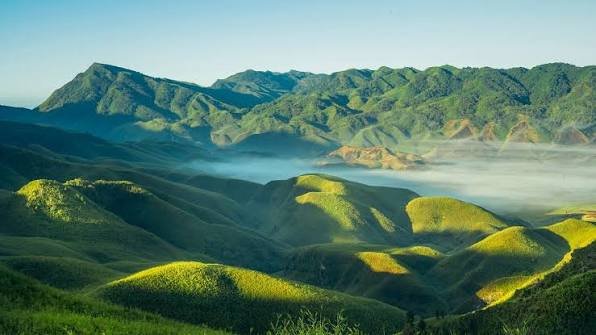
Somewhere along the ridge separating Nagaland from Manipur grows a flower found nowhere else on Earth — the Dzukou lily, blooming for a brief window each June and July across a valley so consistently mown-looking from a distance that early visitors assumed it was maintained by hand. Dzukou Valley, sitting at roughly 2,450 metres just 25 km from Kohima, has become Nagaland’s most iconic trek precisely because of this rare botanical spectacle, though the valley’s rolling green meadows and quiet guesthouse draw trekkers across almost every season, each with its own distinct character.
Dzukou Valley: Quick Facts
| Aspect | Details |
| Location | Nagaland-Manipur border, near Kohima |
| Altitude | Approx. 2,450-2,452 metres (8,000-8,045 feet) |
| Distance from Kohima | Approx. 20-27 km (to trailhead villages) |
| Distance from Dimapur | Approx. 70-89 km (nearest airport and railway station) |
| Distance from Guwahati | Approx. 340 km (7 hours by road) |
| Base Villages | Viswema (easier route) and Zakhama/Jakhama (steeper, shorter) |
| Trek Distance | Approx. 7-9 km one-way to the guesthouse; 16-25 km round trip |
| Permit | Inner Line Permit mandatory for non-resident Indian citizens |
| Accommodation in Valley | Basic rest hut/guesthouse at the trek’s end point |
| Best Time (Lily Bloom) | June to early July |
| Best Time (Clear Trails) | October to February |
| Ideal Trip Duration | 2-3 days (including travel from Kohima) |
How to Reach Dzukou Valley
Reaching Dzukou Valley involves flying or training into Dimapur, driving to Kohima, and then a final road stretch to one of two trailhead villages before the trek itself begins.
- By Air: Dimapur Airport is the nearest, roughly 70-89 km from Kohima, connected to major cities like Guwahati, Kolkata, and Delhi.
- By Train: Dimapur also serves as the nearest railway station, with a shared taxi covering the onward journey to Kohima.
- Dimapur to Kohima: A road journey of roughly 70 km, taking 2-4 hours depending on traffic and road conditions.
- From Guwahati: An alternative starting point, roughly 340 km from Kohima via NH-27, taking about 7 hours by road.
- Kohima to Viswema: The easier trailhead, about 20-27 km away, reached by shared sumo or private taxi in 45 minutes to an hour.
- Kohima to Zakhama (Jakhama): The steeper trailhead, closer at roughly 14-20 km, also accessible by shared taxi.
- Recommended Pacing: Since transport and shops are limited in Nagaland, avoid starting your journey on a Sunday, and plan to reach Kohima the evening before your trek begins rather than attempting a same-day arrival and start.
Best Time to Visit Dzukou Valley
Advice on timing genuinely conflicts across sources, and that’s because Dzukou Valley offers two very different experiences depending on the season.
- June to Early July (Lily Bloom): The window for the rare Dzukou lily and other vibrant monsoon flowers like aconitum, euphorbia, and multi-coloured blooms, making this the top choice for those specifically chasing the flower spectacle.
- June to September (Broader Monsoon Window): Beyond the lily’s short bloom, this stretch keeps the valley lush and green, though trails can be wetter and less stable.
- October to November (Post-Monsoon): Widely cited as the best overall trekking window, with stable weather, crystal-clear skies, dry trails, and golden grass ideal for photography and camping.
- November to February: Favoured by those who prefer dry conditions and quieter trails over flowers, though December specifically draws a different crowd for a separate reason.
- December (Hornbill Festival Overlap): Many travellers combine a December visit with Kohima’s Hornbill Festival, but the valley itself looks notably dry and dull compared to its monsoon appearance, so set expectations accordingly if flowers are your priority.
Choosing Between the Viswema and Jakhama Routes
Since nearly every Dzukou Valley trek starts with this decision, understanding the trade-offs between the two approaches genuinely shapes your experience.
- Viswema Route (Recommended for Most): A gradual ascent with a motorable stretch reducing the walking distance, followed by roughly 2-4 hours of trekking; considered the easier option and generally preferred for a first attempt.
- Zakhama/Jakhama Route (Steeper, Shorter): Closer to Kohima in distance but involves a demanding, near-continuous climb through forest and stone steps, gaining altitude quickly over 5-6 km; better suited to trekkers wanting a tougher physical challenge.
- The Popular Combination: Many experienced trekkers enter via Viswema and exit via Jakhama (or vice versa), letting them experience both routes without repeating the same trail twice — though this requires coordinating transport at both ends.
- What to Expect on Viswema: After reaching the village, a stretch of motorable road followed by a plateau walk leads to the guesthouse, with the most scenic section coming toward the end as the trail actually enters the valley.
- What to Expect on Jakhama: A steep, sustained climb with continuous stone steps dominates the first few hours, making this route noticeably harder on the legs despite covering less overall distance.
- Guide and Group Considerations: Since there are no food stalls or shops along either route, carrying packed meals, water, sunscreen, and appropriate footwear is essential regardless of which path you choose.
FAQs
Q1. Should I visit Dzukou Valley for the lily bloom or for the clearer, dry-season trekking conditions?
It depends on your priority — visit in June or early July if seeing the rare Dzukou lily and vibrant monsoon flowers matters most to you, or plan for October-February if you’d rather have stable weather, dry trails, and clearer mountain views without the flower spectacle.
Q2. Which trekking route is better for a first-time visitor with average fitness: Viswema or Jakhama?
Viswema is generally recommended for first-timers, since it offers a more gradual ascent and a motorable stretch that reduces overall walking effort, while Jakhama’s steep, continuous climb suits those specifically seeking a tougher physical challenge.
Q3. Do I need to arrange the Inner Line Permit before reaching Kohima, or can I get it on arrival?
The Inner Line Permit is mandatory for non-resident Indian citizens and can typically be arranged in Kohima itself, so plan to spend your first evening there both to rest before the trek and to complete this paperwork before heading to the trailhead the next morning.
Q4. Is it worth combining a December Dzukou Valley trek with Kohima’s Hornbill Festival, or should I visit separately?
If experiencing the Hornbill Festival is a priority, combining both trips makes sense logistically, but be aware the valley looks considerably drier and less vibrant in December compared to its monsoon bloom, so manage your expectations if lush greenery or flowers were part of your motivation for the trek.